2014
Saliva and plasma EGFR studies
Foundational research investigated selected variants in patients with non-small-cell lung cancer (NSCLC).
Read the 2014 study and evidence scope
Explore selected epidermal growth factor receptor (EGFR) mutations and circulating tumor DNA (ctDNA) in plasma and saliva.
EGFR exon 19 deletions and L858R are among the variants investigated using EFIRM (Electric Field-Induced Release and Measurement). Later work also examines T790M and other study-specific molecular targets.
Circulating tumor DNA (ctDNA) is the tumor-derived fraction of cell-free DNA. Detecting a particular mutation requires an assay designed for that target; it does not provide comprehensive tumor sequencing.
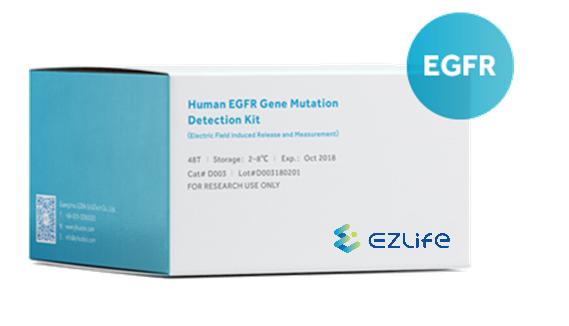
Historical EGFR research-kit packaging · not a current kit offering
Foundational research investigated selected variants in patients with non-small-cell lung cancer (NSCLC).
Read the 2014 study and evidence scopeAnalytical validation research explored selected assays, sample handling and performance.
Read the 2020 study and evidence scopeA microsensor study investigated ultrashort mutation-containing DNA using a research configuration.
Read the 2023 study and evidence scopeTwo primary studies provide useful starting points. Read the full methods, controls and analysis before planning an evaluation.
This study does not certify current product performance, clinical utility or a universal detection limit.
Read the 2020 studyA research prototype, not a current purchasable kit specification or a validated diagnostic panel.
Read the 2023 studyThe 2025 and 2026 saliva reviews summarize a developing field. They do not add a new product validation or establish a screening indication.
Explore all publicationsBring a non-confidential target, sample matrix, comparator and evaluation objectives.
Research use only. Published target detection without polymerase chain reaction (PCR) uses enzyme-mediated signal generation; it does not copy target DNA. These study results are not specifications for an instrument or assay offered today.
Tell us your target variant, sample type and study goals.