The shared chemistry
Target recognition and enzyme reporters also appear in immunoassays. HRP and TMB alone do not define EFIRM.

EFIRM (Electric Field-Induced Release and Measurement) combines molecular recognition, field-assisted interactions and electrochemical readout in one research platform.
EFIRM couples a functionalized electrode surface with a pulsed electric field and enzyme-mediated detection. A biomolecular interaction becomes a measurable current.
Selected assays work directly with plasma or saliva without polymerase chain reaction (PCR) amplification or a conventional nucleic acid extraction step. Sample handling and assay requirements remain protocol-specific.
Interface → binding → electrochemical current
Electropolymerization incorporates capture probes into a conducting-polymer layer on the working electrode.
A cyclic electrical waveform assists complementary target binding at the sensing interface.
HRP oxidizes TMB; the electrode reduces it. Repeated turnover generates the measured current.
Explore the sensing interface, electric-field modulated binding and HRP–TMB redox cycling in a published nucleic acid assay.
An applied electrical waveform polymerizes a conducting-polymer layer at the gold working electrode, incorporating capture probes at the sensing interface. Published nucleic acid methods use polypyrrole (PPy).
The electrode, polymer and molecular probes form one functional interface. This schematic illustrates a published nucleic acid assay; surface formulations vary by method.
Published nucleic acid assay schematic · not to scale. Molecular motion and the current trace illustrate the mechanism. Release and sample preparation are assay-specific; washes and controls are omitted from the drawing.
EFIRM’s platform logic combines how the probe is immobilized, how binding is controlled and how the signal is measured.
Target recognition and enzyme reporters also appear in immunoassays. HRP and TMB alone do not define EFIRM.
A conducting-polymer electrode interface and programmed electrical waveforms connect probe immobilization with control of molecular binding kinetics and stringency.
Conventional colorimetric ELISA reads an optical signal. The illustrated EFIRM assay measures current from enzyme–electrode redox cycling. Electrochemical immunoassays also exist; the distinction here is the integrated EFIRM method.
Changing the recognition chemistry allows new targets to be investigated within an electrochemical architecture. Each application still needs a suitable assay, controls and analytical validation.
Explore how DNA fragment length changes what EFIRM and ddPCR can reveal from the same sample.
EFIRM can recognize some ultrashort mutation-bearing fragments in target-specific assays.
ddPCR measures amplifiable targets through droplet partitioning. Fragment coverage depends on the assay design.
Together, matched measurements help researchers explore differences in abundance and fragment composition.
Research illustration. Assay performance depends on the target and specimen. Research use only; not for use in diagnostic procedures.
Cell-free DNA (cfDNA) consists of DNA fragments found outside cells in body fluids. Circulating tumor DNA (ctDNA) is the tumor-derived fraction of that pool. Detecting a selected mutation requires a target-specific assay; measuring total cfDNA alone does not identify its tumor origin.
Mononucleosomal ctDNA (mnctDNA) refers to tumor-derived fragments associated with a single nucleosome, the protein structure around which DNA is packaged. Cell-free mononucleosomal fragments commonly cluster near 166 base pairs, but their lengths vary. Ultrashort ctDNA (usctDNA) describes a shorter population, including fragments of only a few dozen nucleotides in published studies. Definitions and size cutoffs differ between studies. These fragments may still retain a mutation-bearing target sequence. Base pairs (bp) describe paired DNA length; nucleotides (nt) describe the units in a strand.
Droplet digital PCR (ddPCR) partitions a sample into droplets, amplifies a selected DNA region and estimates target abundance from positive and negative droplets. A fragment must retain the sequence needed by that assay, including the relevant primer-binding sites. Fragments shorter than the required amplification region may be missed. This is a design constraint, not a universal inability of ddPCR to detect short DNA: specialized short-target and stem-loop assays can detect ultrashort fragments.
EFIRM (Electric Field-Induced Release and Measurement) combines field-assisted molecular interactions, target-specific probe recognition and electrochemical measurement. In selected published DNA assays, hybridization at the sensor surface produces an enzyme-mediated electrical signal without PCR amplification of the target. Some ultrashort fragments that retain the required recognition sequences can therefore contribute to the measurement. Capture efficiency and signal generation remain dependent on the assay, sequence and specimen.
At a fixed total amount of ctDNA, increasing the ultrashort fraction can reduce the number of molecules accessible to an assay requiring a longer target region. For teaching only, the model assumes that all fragments retain the EFIRM recognition sites, while only the longer fragments retain the target region required by the illustrated ddPCR design. In this idealized example, 50 target copies with a 70% ultrashort fraction yield 15 accessible copies for the illustrated conventional ddPCR design and 50 for the illustrated EFIRM design. When the total falls to 10, the corresponding model inputs become 3 and 10.
The shared threshold of 6 accessible copies per reaction is a teaching assumption, not a clinical specification. Bars and stars represent relative model signals, not interchangeable physical measurements; EFIRM current is not itself a direct DNA copy count. Real detection is probabilistic at low copy numbers and depends on sample volume, recovery, fragment structure, background, controls and assay-specific validation. A result below a detection threshold does not prove that the target is absent.
A matched research comparison would control specimen handling and input volume, test standards carrying the same variant across different fragment lengths, and include blanks, wild-type controls and repeated low-copy measurements. Recovery, specificity, reproducibility and assay-specific detection limits should be assessed. Comparing EFIRM with both the relevant conventional ddPCR assay and a suitable short-target design can help distinguish fragment coverage from other analytical effects. This is a proposed evaluation approach, not a completed clinical validation.
Fragment-aware assay design may help recover mutation information that would otherwise be missed when tumor-derived DNA is scarce. This is relevant to research on low-abundance variants and longitudinal molecular monitoring. It also helps explain why two platforms can disagree on the same specimen without either result alone establishing the true disease state. The animation does not demonstrate earlier cancer diagnosis, reliable residual-disease detection or improved patient outcomes; those uses require their own clinical evidence.
Research context: A 2020 EGFR study investigated length-dependent detection and included paired plasma and saliva specimens from 13 patients with non-small-cell lung cancer. A 2024 study used a specialized 42-bp stem-loop ddPCR assay for HPV16-associated urinary ctDNA; this was a different target and specimen context, not a head-to-head comparison with EFIRM. These findings support assay-specific comparisons rather than a universal ranking of technologies. EZLife products are presented for research use only, not for use in diagnostic procedures.
Read the 2020 EFIRM fragment study · Read the 2024 ultrashort ddPCR study
A look at plate handling and the software workspace in an earlier EFIRM research setup.
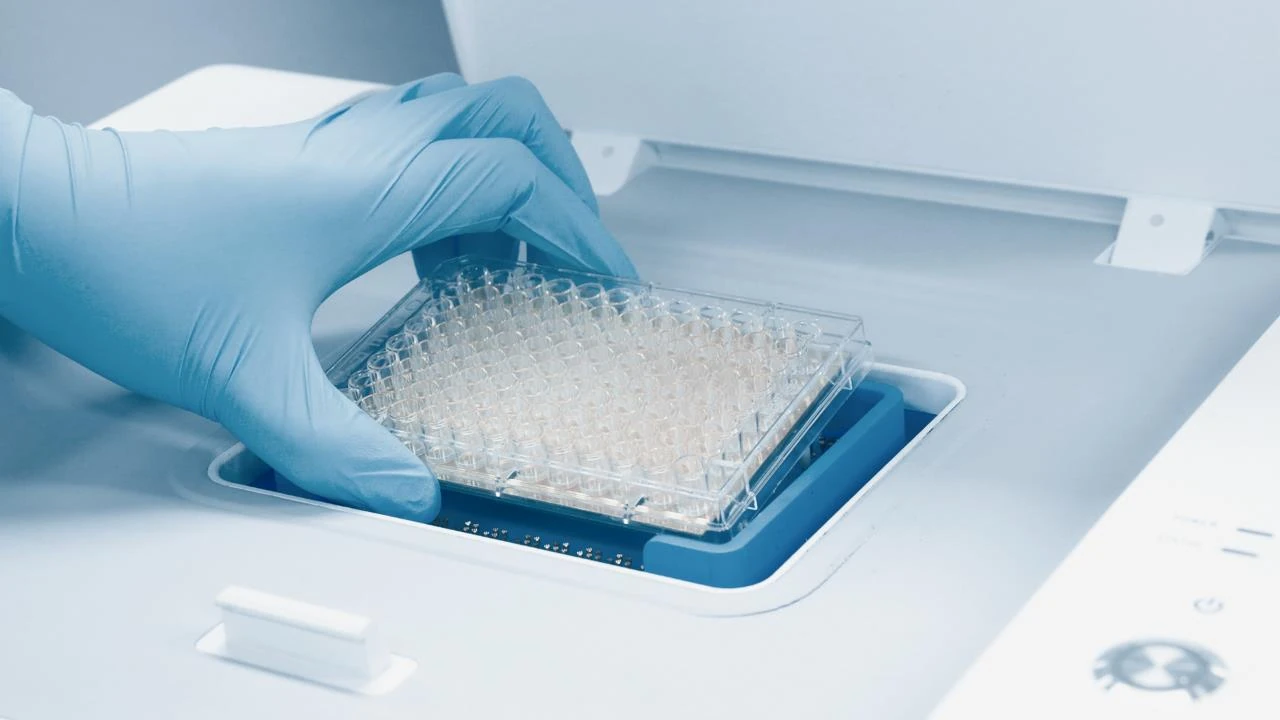
Positioning a research plate on the instrument.
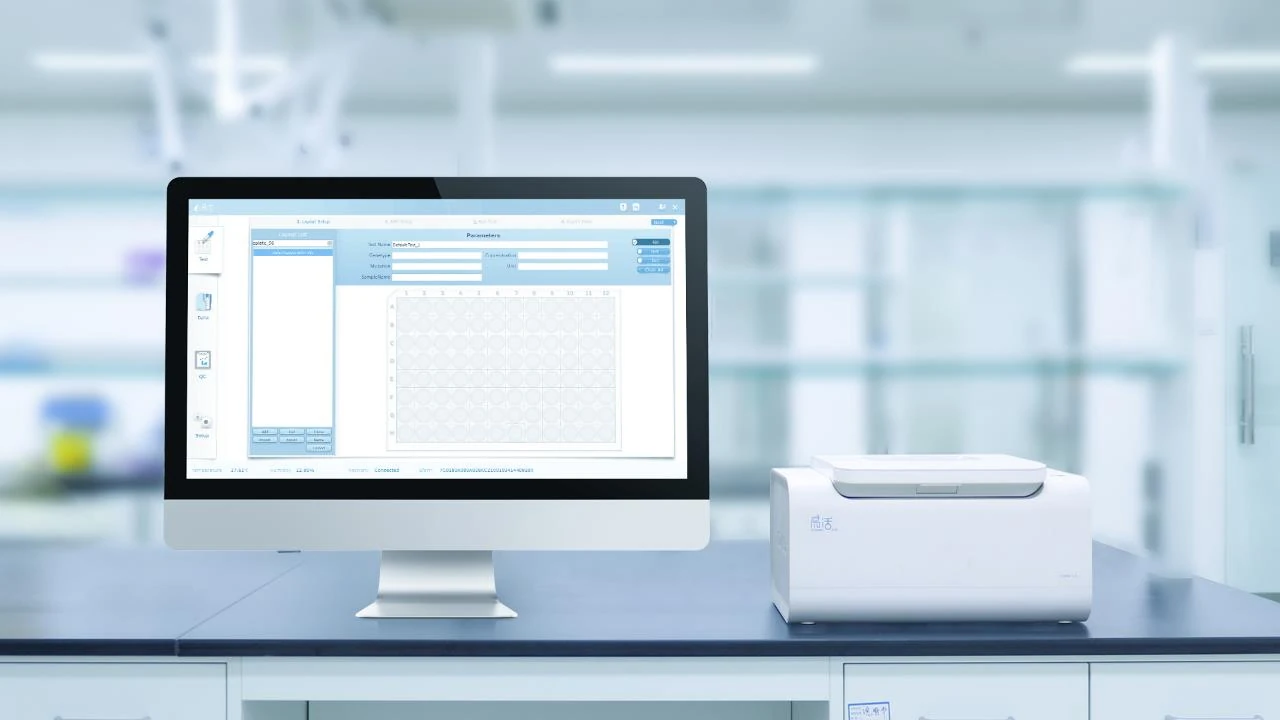
A plate layout interface alongside the research instrument.
EFIRM connects electrical control, conducting-polymer interfaces and enzyme–electrode signal generation.
Programmed electric fields modulate target transport, hybridization kinetics and binding stringency at the sensing interface.
Electropolymerization incorporates capture probes into polypyrrole on a working electrode, connecting molecular recognition to a controllable surface.
Target-associated HRP catalyzes TMB oxidation with hydrogen peroxide. Electrode reduction regenerates TMB, creating repeated signal turnover without copying target DNA.
Target-specific recognition chemistry, specimen handling and controls define each assay. Published studies document the method’s evolution and its application-specific limitations.
From electrochemical recognition to liquid biopsy research, successive studies refine the target, specimen and measurement method.
Researchers measured salivary IL-8 mRNA and protein with an electrochemical sensor, connecting different recognition chemistries to electrical readout.
Read the studyAn exosome-specific research method combined magnetic-bead enrichment with field-assisted RNA release and measurement of a surface-associated protein marker.
Read the studyA saliva and plasma study investigated selected EGFR mutations in lung cancer cohorts, extending the research into target-specific mutation detection.
Read the studyAnalytical research examined selected EGFR assays in plasma and saliva, including variant-specific performance and specimen handling.
Read the studyResearch methods evolve across studies. A result for one target and protocol does not establish performance for every assay or for a current product configuration.
Published examples span human biomarkers, vesicle-associated signals, food authenticity and agricultural testing.
Complementary capture and detector probes connect selected mutation sequences to PCR-free electrochemical measurement.
Evidence & stage
Human cohort research; selected variants. Further analytical characterization was published in 2020.
Magnetic beads enrich exosomes before electric-field-assisted release of RNA for capture. A surface-associated protein marker is measured without vesicle rupture. Electrical release provides target access; the beads perform separation.
Evidence & stage
Foundational laboratory and mouse-model research. Release is part of this assay, rather than every EFIRM workflow.
Four separate assays connect distinct recognition chemistries to an electrochemical platform. The viral RNA workflow includes isothermal amplification (RT-LAMP) and restriction digestion.
Evidence & stage
Separate singleplex research assays, with assay-specific preparation. The neutralizing-antibody assay is competitive; higher antibody activity gives lower current. Not a clinical indication or current kit specification.
Species-specific DNA recognition connects meat identity research to PCR-free electrochemical readout, with sample treatment before measurement.
Evidence & stage
Published food-authenticity research. A route to species identification studies beyond human biomarkers.
Event-specific DNA recognition is evaluated against real-time PCR in a blinded soybean cargo study.
Evidence & stage
Published research by external academic and food-testing groups. Event-specific evidence, rather than a universal GMO assay.
Antibody assays extend the recognition chemistry beyond nucleic acid hybridization.
Evidence & stage
Research in two Danish cohorts. Read the associated corrigendum with the original study.
These are published research applications across different assay configurations. They do not establish current EFIRM96 specifications, kit availability or diagnostic authorization. Explore the publication library for authors, methods and study scope.
Browse the publication library →Our research thesis: reliable longitudinal molecular data is a critical missing layer for future AI-enabled health research.
EFIRM96, EPLATE and software provide a laboratory platform for research and assay development. An automated prototype is available for demonstration and discussion with investment organizations and CLIA laboratories. It is a prototype, not a commercially available or clinically validated product.
Electrical control and current readout offer a route to miniaturization. Our longer-term goals include handheld instruments and smartphone modules, paired with appropriately validated assays.
Repeated saliva sampling could support molecular observations across time and physiological states. Carefully designed cohorts and reproducible measurements could create a data layer for future model-based research.
The path requires hardware development, assay validation, longitudinal studies and responsible data analysis. Handheld and smartphone products, continuous monitoring and AI-based clinical interpretation are future research goals.
Help develop the next research platformSelected EFIRM assays measure target molecules without PCR-based nucleic acid amplification.
Enzyme chemistry enhances the measurable electrical signal. “PCR-free” does not mean “no signal amplification.”
Limits of detection, sample volume, timing and reproducibility depend on the target, sample type (matrix) and validated protocol.
Discuss your research goals, platform needs or a new scientific collaboration.